Search This Blog

Showing posts with label Christianity. Show all posts

Tuesday, 12 June 2012

Gay humanists rubbish attack on same-sex marriage

Britain’s only independent gay humanist organisation, the charity the Pink Triangle Trust (PTT) – owner of this blog – has rubbished the latest attack on same-sex marriage by the Church of England in its submission to the government’s consultation on this issue.

Commenting on this, PTT secretary George Broadhead said: “This is part and parcel of the Church’s long-standing Bible-based hostility to gay rights. It is fatuous to claim that the Church or its places of worship will be badly affected by this progressive legislation since it concerns only civil marriages in register offices. Moreover, as the courts are well aware of the distinction between civil and religious institutions, it is equally fatuous to claim that these marriages will result in legal challenges that will force any church to marry same-sex couples.

“As usual, the Church is out of touch with public opinion which, as polls show, is overwhelmingly in favour of same-sex marriage. No wonder the Church’s members are deserting the pews in droves.”

I think I agree, mostly, with George. However, there may, just may, be a successful challenge in the European courts, but that would just put the Church where other employers are at the moment, and we know that, for instance, a registrar lost her case, as did a marriage-guidance counsellor, because each refused to treat gay people the same as heterosexuals. One has to ask: why won’t it be the same with a minister of religion, carrying out part of the duties for which he receives a stipend and for which he is, in this case, licensed by the state to carry out marriage, as is a registrar?
So I can see that the Church may be worried, although I suspect much of its “concern” is born out of bigotry. If you want to win an argument, you reach for all kinds of things to bolster it.

If it does go to a European court, it will be an interesting case to follow.

And one of the issues the Church has raised is consummation of a marriage. On the BBC News website, the Beeb’s religion guy, Robert Pigott, writes: “For the Church, a marriage – with its focus on procreation and the need to be consummated – is something that is simply not available to gay couples. By creating different understandings of marriage, it insists, the whole institution will be weakened – something the nation should not be allowed to sleep-walk towards.

Er, how does an opposite-sex relationship differ from a same-sex one in this respect? My Concise Oxford defines consummation simply as “make (a marriage or relationship) complete by having sexual intercourse”. Don’t gays do nookie? Sorry, I thought they did. I must be missing something.

As for the focus on procreation, well clearly the Church doesn’t say a marriage is null and void if procreation doesn’t happen, because there are all kinds of reasons why it might not: family planning, a woman’s infertility, husband firing blanks. But the Church presumably doesn’t believe that childless marriage has any less worth than one that irresponsibly produces six or seven sprogs.

And, unlike the Catholic Church, the C of E doesn’t get uppity about people who want to use condoms and other forms of contraception, so, by implication, it’s cool about people who actually choose not to have kids.

So, as usual, the argument of the religionists doesn’t stack up.

Saturday, 31 March 2012

And lead us not into meaningless twaddle


Old Beardy – a.k.a. the Archbish of Cant – reckons the Lord’s Prayer should be taught in all schools.

Er, am I missing something? I mean, er, why?

He said: “I’d like to see schools introducing children to the Lord’s Prayer, so that they know that it’s there, they know what it means and know why it matters.

“Then they may make up their minds about whether they use it.”

Well, at least he recommends some choice in the matter of whether they use it, but why waste time on the Lord’s Prayer when there are other, more poetic texts that could be learned?

I used to memorise a few Shakespeare sonnets, for instance (did the same with the opening of Under Milk Wood). As well as the pleasure that comes from occasionally reciting them to oneself (when no one’s listening!), the old Bard contains more truth in his verse than the Lord’s Prayer, which just does the usual of saying, Hi, God, you’re great, now please give me some bread and, hey, don’t beat me up over stuff I’ve done, because, well, the glory’s all yours for ever, dude.

I can recite the Lord’s Prayer – and, for that matter, most of the Ten Commandments. It was drummed into me decades ago at school. It’s a minor achievement, but I don’t know that my ability to recite either has done me any good – and here I’m thinking back to before I began to question religion in the way I do now.

Perhaps kids ought to learn a few protest songs instead. Perhaps they should look at how religion in this country goes hand in hand with the government that’s taking their benefits away; that’s going to deter so many of them from going to university because of the enormous tuition fees; that’s privatising the National Health Service, thus ensuring that the bottom line will be put above health and wellbeing; that’s presiding over rocketing prices in fuel, which will work their way into everything the kids need, because manufacturing, processing and transport costs will all rise as a result.

I’m sure readers of a like mind could come up with a few dozen more things it would be better to have kids learn, or learn about, than the Lord’s Prayer.

But, like so much that kids are fed through TV and the Internet and rampant consumerism, cosy little jingles like the Lord’s Prayer – and all the other religious flimflam they’re stuffed with in school – will keep their minds off the more important things, and they’ll be less likely to make a fuss as they grow older.

Wednesday, 29 February 2012

Let us pray … if you want to … in silence

Back to prayers again, and Cheltenham Borough Council in Gloucestershire has decided to hold a silence instead of prayers.

This could be a way forward. The Christians can’t complain that their dogma is being shoved out, because those councillors who take part can pray to whatever deity they like, or, if they have no beliefs, simply reflect on what they’re about to do and express the internal hope that their deliberations will be to the benefit of all.

This is an alternative to my suggestion in these posts that councillors who want to pray go to an anteroom (or as many rooms as there are different belief systems, if that’s desired) and do their thing there.

If compromise there has to be, then let it be this. The Cheltenham silence was led by a preacherman, but it doesn’t have to be.

Saturday, 25 February 2012

Don’t like praying? Then don’t be a councillor!


A councillor who walked out of a meeting to avoid the obligatory prayers was told by members of the public present that he shouldn’t have become a councillor if he didn’t want to say prayers.

This is according to Britain’s National Secular Society (NSS), which has been fighting to get this nonsense stopped for ages now. It doesn’t, as far as I can tell, object to prayers per se, but not as part, albeit that they come at the start, of meetings, which should be secular.

And that makes sense of course: it allows people who don’t wish to say Christian prayers, for a variety of reasons, not to have to take part in this pointless ritual; it means a meeting can get going at three o’clock sharp (or whatever) without having some babbling idiot spout mumbo-jumbo.

And prayers, for those who want them, could be said at 2.50 in an anteroom, or several anterooms to cater for those of different religious persuasions. No problem.

The latest story concerns Sandbach Town Council in Cheshire. Cllr Richard Hoffman walked out, and told the NSS: “As I was leaving the room I was verbally abused by three members of the public saying I should be ashamed of myself, and that I shouldn’t have stood for the council if I didn’t want to say prayers.”

So there are people who actually believe you must be religious if you want to serve your community as a town (or county) councillor.

The NSS report continues: “The town mayor Dennis Robinson is reported to have told the local Crewe Chronicle that removing traditional prayers would be an ‘attack on Christianity’. He opened Thursday’s meeting by saying: ‘Anyone who wishes to leave may do so now.’”

And Hoffman duly did, it seems, and got a bollocking for it from members of the public.

A neighbouring authority, Middlewich Town Council, says it’s taken prayers off the agenda and will hold them five minutes before meetings officially starts.

So it can be done, see?

Saturday, 18 February 2012

Let us pray! Will those in favour say aye …

If the UK government doesn’t like something that the courts have ruled on, in spite of often championing the justice system here, it will just trample all over it.

It makes a mockery of the justice system if all it takes when, in this case, God-bothering idiot ministers can just – effectively – reverse a decision of the High Court.

We reported on 10 February how the National Secular Society had scored a victory against a Devon town council – Bideford – which insisted, along with so many other local authorities, on having Christian prayers as part of the meeting, whether members present were Christian, Muslim, Sikh, Jedi or of no religion whatever.

Let’s be clear first about what the NSS wanted: no prayers as part of the meeting (they’re usually held just before business begins, but nonetheless as part of the official proceedings). The NSS seems to have no objection to prayers held elsewhere in the council offices before the meeting begins.

Not only does this get over inflicting this mumbo-jumbo on people who don’t want it – or forcing them to come into the meeting late, and get a raised eyebrow from the mayor or chair – but it simply allows those who wish to pray to do so, among like-minded people, without knowing there are others in the meeting who are quietly mocking this quick chat with sky fairies.

Now, after that victory, our bloody government has decided to hurry forth a measure – part of the Localism Act – that will let councils ignore the ruling and just get on with the prayers, and anyone who finds it an embarrassment can just put up with it.

This measure is being fast-tracked by Eric Pickles, laughingly called the Communities Secretary – although, being a lard-arsed Tory, would not really know much about genuine community (the very word community would probably smack too much of socialism).

This is what the idiot Pickles says about it: “By effectively reversing that illiberal ruling, we are striking a blow for localism over central interference, for freedom to worship over intolerant secularism, for Parliamentary sovereignty over judicial activism, and for long-standing British liberties over modern-day political correctness.”

The italics are mine. Just ponder on the adjectives, the clichés, the sleight of mouth with such terms as “central interference” (what’s he doing now but using central interference?). Then there’s intolerant secularism. Is any form of secularism not intolerant in his mind?

As for “illiberal”, if Section 111 of the Local Government Act 1972, on which the judge based his judgment last week, is illiberal, why has it been allowed to remain on the Statute Book for 40 years?

These bozos won’t be happy till we’re living in a virtual theocracy.

Wednesday, 15 February 2012

Dawkins on militant secularism

Further to yesterday's post about Baroness Warsi and her trip to La-La Land, her encouragement to us all to embrace religion and her talk of so-called militant secularism, there's an interview with Richard Dawkins embedded below that you might like.

The main point he makes – for me, at any rate – is this: secularism is not atheism. He emphasises that there are religionists among secularists. All secularism seeks to do is kick religion out of the pubic square.

Its inclusion, big time, is exemplified in this country, the UK, of course, by the fact that we have an established church in the form of the Church of England, and it gets included in all kinds of aspects of public life, be it a coronation, a state funeral, a memorial, even the opening of each day's session of Parliament.

Only this week have we seen a victory by secularism over having religion forced on us when a judgment ruled that it was illegal for local councils to hold prayers at the start of – and that means as part of – council meetings.

The religionists began to beat their chests, and their drums, and possibly the nearest secularist, of course, saying Christianity was being sidelined. The National Secular Society was quick to point out that it has no objection to prayers, just not those that are part of an official meeting of an official secular body whose membership is likely to include people of other religions and of none.

By all means pray, it said, but do it in an anteroom before the council meeting begins, and people can then decide whether or not to join in.

That is what is meant by taking religion out of the public square, not damning it to obscurity, not telling others they can't practise it. People should be free to practise whatever religion they wish to, and many of them, fortunately, recognise that some of us don't wish to, and that we should not have it rammed at us from all sides when we wish to go about our secular business.

So, when religionists try to tell you that secularists are attempting to outlaw religion, or at least marginalise it, you can tell them where to stuff their religion. If they don't try to tell you that, you can wish them all happiness in their beliefs as long as they don't try to inflict them on you.

Friday, 10 February 2012

A whinge and a prayer

Here’s something Britain’s National Secular Society has been fighting for for yonks: an end to prayers before council meetings.

And it’s got its way, having fought a town council in Devon in the courts.

It will have repercussions for councils all over the country now, of course.

As you would expect, Christians aren’t too pleased that this ritual has been outlawed. One whinges that the ruling is “bizarre”.

The NSS fought it on human-rights grounds, but Justice Ouseley ruled it was unlawful on technical grounds

Prayers, he said, were not lawful under Section 111 of the Local Government Act 1972. “Mr Justice Ouseley said the prayers were unlawful because there was no statutory power permitting the practice to continue,” says the Beeb.

You can read the full story on the BBC website here.

Saturday, 21 January 2012

Abortion ads on TV? Wait for the proverbial to hit the fan

This is going to be a helluva can of worms. God botherers will be out in force.

“Private clinics that charge for pregnancy services including abortions will be able to advertise on television and radio under new rules,” says the BBC.

The new law takes effect in April.

One comment beneath the BBC story says, “Abortion is always a terrible thing whatever your ethical and moral beliefs on the issue.”

And that’s true. I’m not sure about advertising abortion clinics when, say, murderous tobacco can’t be advertised. I’m not comfortable about abortion on demand as a form of contraception. I don’t feel qualified to state an opinion, although such a lack of qualification won’t stop what I expect will be a deluge of protest.

I do believe, however, that abortion should be available on demand when a mother’s life or wellbeing is at stake, where there’s been a rape, even when the baby might suffer a shitty life because of a known serious problem with its brain or limbs. And I believe the Catholic Church should be put publicly in its place when it gets on its high horse about abortion.

I recall one story from Brazil in which anyone who helped a young, frail girl to have an abortion – a young, frail girl who’d been raped by her stepfather and was expecting twins – would be excommunicated, and that meant doctors and her mother. Whatever you think of the damnably silly business of excommunication, it’s a serious thing to devout believers and can ruin their lives.

This little girl might not have survived the birth. Fortunately, the abortion went ahead.

We reported on that in 2009 – rather angrily, as I recall.

But abortion nonetheless is not something that should be taken lightly. And the reason I mention the ads story at all is that it will be the religious element that will bleat the most, as if no one else could put forward a moral case for or against advertising abortion clinics. My reference above shows that religion can’t take the moral high ground in such matters.

Decisions should be taken on medical and social grounds, not because an imagined deity might not like the idea – a deity, it has to be said, that sanctions genocide and other horrors in the Old Testament.

Saturday, 12 November 2011

Why secularists make Christians angry (and vice versa)

A report from Premier Christian Media is highlighting how Christians feel more persecuted. The rise of secularism is one thing that is blamed for this.

But it’s cause and effect. If Christians (and other religions, notably Islam) didn’t make ridiculous demands, secularists would be less vocal. It becomes a game of ping-pong, with each side trying to hit the ball harder each time it comes to its end of the table.

If secularists complain that there’s too much religion on TV, say, that’s probably because there is (disproportionately so), and the BBC and other broadcasters are guilty of kowtowing to these beliefs, instead of – as I’m sure would be quite acceptable – making interesting programmes about religion to enable us to increase our knowledge, just as we might seek to increase our knowledge of cooking by watching Jamie Oliver. (No, scrub that. TV cooking is just a spectator sport for morons, but I digress.)

I’m not saying secularists are always right – and often one wishes they’d stick to secularism if that is their only remit, and stop pontificating on spiritual matters or issues of ontology and theology. After all, secularism is just a case of wishing to chuck the churches and other religious organisations out of public decision making and put them on a level playing field with any other group that seeks the ear of those in power.

If secularists have “humanist” in their name, then that’s a different matter, because the term “humanism” seems to have such a wide scope that it invites its devotees to say just about anything. However, not all humanists are as freethinking as they like to make out, and some so-called freethinkers can be quite dogmatic, as a glance at the letters pages of the Freethinker will confirm.

But, on the whole, secularists pure and simple or secularists who are humanists, rationalists and/or freethinkers have the moral high ground as far as this humble blogger is concerned. Religion is a huge power game, and should be put in its place. It’s far removed from the simple sets of beliefs that probably gave rise to it. Spirituality is a personal thing, as is belief in gods and other supernatural agencies.

Most secularists would argue that people should be allowed to enjoy their beliefs, practise their rituals, celebrate their festivals, honour their deities – as long as they don’t wish (a) to push it all down everyone’s throat or (b) to restrict others’ freedom, either to have religious beliefs or not to have religious beliefs.

And that, if anything, is the strongest case for keeping religion in the private sphere. I’m sure few people object to a bit of sentimental hokum at Christmas, say. I for one like the sound of carols, and the odd crib scene in a town centre doesn’t send me into a vapour; church bells can be pleasing to the ear, provided they don’t keep one awake or frighten the horses. Christianity was here a long time before it began to decline, and it’s informed much of our culture.

If I saw a harmless display celebrating Diwali, say, I’d think the same.

But religionists who shout and throw their toys out of the pram can turn mild secularists into raging, uncompromising fanatics, complete with pitchforks and torches.

Wednesday, 2 November 2011

An equality too far?

“Human rights campaigner Peter Tatchell has come to the defence of a Christian housing manager who was demoted over remarks be made on Facebook opposing same-sex marriages,” the Christian think tank Ekklesia tells us.

Ekklesia goes on to make the pertinent remark: “This is the fourth time that Tatchell has come to the defence of Christians who have become embroiled in controversy over their stance on LGBT issues.”

He spoke last year in defence of a street preacher who held antigay views. His stance was that of free speech. I for one – but I can’t speak for others on the list of potential contributors to this blog – agree with him. Once we start mucking about with free speech, even if that speech is railing against our own interests, we deliver a blow to that very principle, and will soon fall into the hands of those who would like it curbed altogether.

What’s more, by showing to those who would deny us free speech, free expression and freedom to be ourselves when it comes to our sexuality that we believe they have the right to make their banal statements, we take the moral high ground. And we can demand a reciprocal arrangement, and our opponents would look bad if they refused it.

“In the latest case,” says Ekklesia, “Adrian Smith, a Christian, was found guilty of gross misconduct by his publicly funded housing association for saying that allowing gay weddings in churches was ‘an equality too far’.”

He’s entitled to his views. It’s good that the housing association concerned doesn’t like his views, and should, of course, speak loudly against those views, but he said this in a private capacity. He’d put it on his personal Facebook page. But for that he was downgraded to a lower posting and lost £14,000 a year.

Smith says on his Facebook page that gay marriage is

an equality too far [. . .] the bible is quite specific that marriage is for men and women if the state wants to offer civil marriage to same sex then that is up to the state; but they shouldn’t impose its rules on places of faith and conscience.

So the guy’s a prat for having views on human relationships in the 21st century that are clearly based on mythology and fly in the face of all that is decent. But let him have them. Argue with him using debate and, if necessary, ridicule.

Wednesday, 7 September 2011

What a bunch of winkers!

A picture of a religious figure winking is disrespectful – so disrespectful, in fact, that it’s been banned by Britain’s Advertising Standards Authority (ASA).

Jesus – not only winking but giving a thumbs-up sign – appeared on a mobile phone ad just before Easter this year. I’ve looked in vain for a picture, but the various news sites that carry the story – well, the ones I could be bothered to look at, anyway – have avoided using the pic, including the BBC and the Independent.

The BBC says that “the Phones 4U advertisement was ‘disrespectful’ to the Christian faith and must not be used again”. The inference we must all draw is that it’s disrespectful to use a figure that’s revered by millions of people, but if it’s Jesus it’s wrong and if it’s, say, John Lennon or Lady Gaga it’s OK.

Sorry, but I don’t see the difference. Either you’re hurting people’s feelings or you’re not.

Oh, I was forgetting. It’s disrespectful only if the figure concerned is part of a myth.

Anyway, I’d have thought a Jesus winking and giving a thumbs-up would please the Deluded Herd. It seems to be saying Christianity is cool.

But, then, the ASA has been known to be a pusillanimous bunch of twats before, as we saw on this blog nearly a year ago when it cosied up to the Catholic Church and banned an ad showing two male priests about to kiss – on the strength of a handful of complaints.

Why doesn’t it concentrate on ads for stuff that’s harmful, such as most fast foods, mobile phones aimed at kids (think of the radiation) and clothes made in sweatshops – to name but a few dodgy products?
___________________

UPDATE: Since I wrote the above my helpful commenter Logicelf (see comments) has kindly sent me a link to a picture (for which thanks) on the Sky website:

Thursday, 31 March 2011

It's child abuse! Children AS YOUNG AS 4 to be 'educated' in atheism! What is the world coming to?

Yes, it's a long headline above, and reflects this blogger's pissed-off-ness with the likes of the Daily Hate (sorry, Mail – old habits die hard).

Its headline screams: CHILDREN AS YOUNG AS FOUR TO BE EDUCATED IN ATHEISM.

What is really happening is that humanism will be incorporated into religious education in primary schools in Blackburn with Darwen, Lancashire (in the north of England), to accompany the religions that are there: Christianity, Hinduism, Sikhism, Judaism, Buddhism and Islam. So kids will be told that certain religions exist, and this is what they say, and that there are people who don't do religion, and this is what they say.

Simple and, if you're going to teach religion at all, sensible. Religions can then be put into a context: that there are people who have no religion and there are people who have.

But it's not just the Mail's take: it's also lousy journalism. A Mail hack knows he can get away with the utmost shit if it leads to a screaming headline with some sensationalism in it, manufactured though that sensationalism is in this case.

So he gets brownie points.

However, if you read on you realise it's a story that comes down in favour of humanism and the new bit of the curriculum. There's even a priest quoted:

Reverend Kevin Logan, a local journalist, author and religious community leader, said: "It is quite a change but it is completely right to recognise atheism and humanism.

"They are religions like any others. It is just that people worship man instead of a god.

"I am certainly not worried about Christianity. It can stand against any belief and come out in a good light."

And others quoted in the story come out in favour of a more sensible approach, too. So why do the headline (which is down to the subeditor, usually, not the writer) and the intro make out it's a crime against humanity to teach kids as young as four about atheism?

And nowhere, you'll note, does it venture to suggest that it's perhaps more dangerous to teach kids as young as four about religion, rather than leaving that till later in their school lives, when they are better able to offer critical judgement.

Saturday, 29 January 2011

The real Stephen Green

So now we know the real Stephen Green, it seems. He beat his wife, he beat his kids, he made his family's life a misery, according to his ex-wife.

Read all about it, as they say, in this story in the Daily Mail. It's quite a revelation.

Oh, how are the mighty – or, in arch homophobe Green's case, the deluded hypocrites – fallen!

Does this mean we'll be spared his dangerous ranting in future? Let's hope so. Rather, let's hope he's thoroughly discredited in the eyes of his followers, and that they will come to see the light – but not the light that Stephen Green espoused.

Saturday, 25 December 2010

What’s in a name?

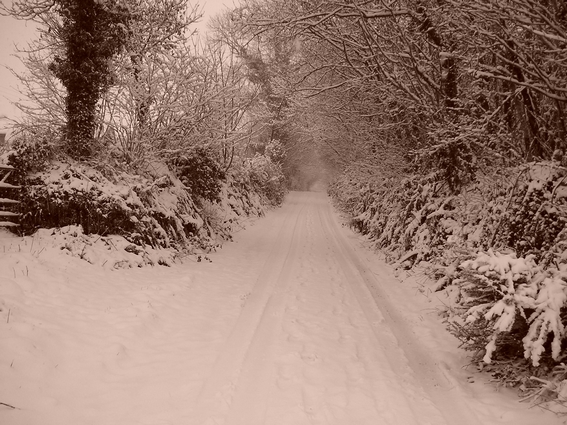
The lane from chez nous in rural Wales leading up to the nearby village

Greetings, and a happy Christmas, all! No, I don’t balk at using the word “Christmas”. What, as the Bard asked through Juliet, is in a name? That which we call a festival by any other name would be as merry – potentially, anyway.

I’m no apologist for Christianity. I recognise its role in Western history and what it has brought, culturally, to our way of life and the language we use. I also recognise that, without it, other influences would have come to bear, but humankind would still have built its moral code, because a moral code comes not from a religion, but from humanity.

That people attribute their moral code to their Christianity or their Islam or their Hinduism or whatever is entirely up to them, and that may be the top layer, as it were, of the articulation of what is their code of ethics and mode of living.

Beneath it, though, is that thing humanity. It was the human in us that devised the religion that in turn codified our outer persona, the one we present to the world, the principles we live by. Most people are probably essentially good, but with flaws. Some are essentially bad, but are so because of their belief in religion’s edicts and diktats.

Some, of course, are just bad. I have a few politicians in mind, but let’s not go down that road, tempting though it may be.

That said, if people find comfort in a belief system and don’t wish to dictate how others should live their lives, I’m OK with that.

So I’m no apologist for Christianity, but it’s given its name to the midwinter festival that punctuates the seemingly relentless darkness and (in the UK at the moment) coldness and misery of winter, and brings us hope of a new season on the way. Bit of a laugh in the UK, of course, where we don’t seem to get proper summers any more, but there you go.

I’m not one to go about saying “Happy holidays!” or “Happy Yuletide!” It would make be seem a bigger prat than I already am. So it’s “Merry Christmas and happy New Year!” That’s the expectation, and those who know me know that I use the term “Christmas” as a descriptor. Saying the word doesn’t make people believe more in the mythology.

I leave it to my learned blogging colleague George Broadhead, secretary of this blog’s parent, the Pink Triangle Trust, to tell us the true origin of Christmas, though.

Atheists, agnostics, Humanists and other unbelievers are sometimes asked why they celebrate at Christmas time, or are even accused of being hypocritical for doing so.

The answer is that they celebrate at that time for the same reason as the early Christians – because everyone else was already doing so, and had been for centuries before the birth of Christ.

The last two weeks of December had long been a time of celebration throughout the ancient world in the northern hemisphere. It was associated with the Winter Solstice, the shortest day, after which one could look forward to Spring, to crops, regeneration and new life.

Almost all the customs of the Festive Season pre-date Christianity: the giving of gifts, decorating the house and tree, putting up holly and mistletoe, and eating the flaming round plum pudding – the most obvious solar symbol of all. And the familiar crib scene originated in ancient Egypt.

Among the Romans, the Festival of Saturnalia, which began on 17 December, involved the hanging of greenery and laurel leaves, the lighting of candles and the giving of presents. Like the present Festive Season, theirs was a season of goodwill.

In the third century AD there was great rivalry between Christianity and Mithraism, especially among the soldiers, upon whose support the Roman Emperors depended. Eventually, early in the fourth century, the Emperor Constantine decided in favour of Christianity but, during the rivalry, the Christians could not afford to appear killjoys in December when Mithraic soldiers were celebrating the triumph of Good over Evil.

The 25th of December may be attributed to the fact that in the year AD 274, at a time when the Roman emperors were trying to replace the ancient Roman polytheism with sun worship, the Emperor Aurelian declared 25 December to be the Sun’s official birthday.

So those who have no religion (47% according to the British Social Attitudes Survey, January 2010) need have no qualms about celebrating at this time of the year if they wish.

And with that, here’s hoping for happy holidays, happy Winter Solstice, happy Christmas, happy whatever you want to call it to all of Pink Triangle’s readers, and we all hope you have a great New Year.

We’re putting our feet up for the rest of the holiday and will be back with a few choice entries early in the New Year, by which time we may have sobered up a bit.

Friday, 24 December 2010

How the BBC ‘offended’ Christians

Yeah, but wheres the halo?
I’ve been watching The Nativity on BBC1. Not bad as these things go. I like TV drama, and I don’t really care – when a drama is based on myth – which myth the said drama is depicting.

Note the word “myth”. Were it about, say, the ancient Greek pantheon or the stories in the Bhagavad Gita I’d probably still enjoy it – if it were well enough written and performed. The Nativity is OK – not brilliant, but watchable. So I committed four half-hours to watching it.

Now it seems that some Christians don’t like it. That may surprise you, until you learn that it’s because the so-called Virgin Mary is “portrayed” as a whore.

I happened on a Christian website called The Way the other day, and on an undated page one Amanda Hopkins writes a short post beginning: “Christians have reacted angrily to a BBC production which portrayed the Virgin Mary as a prostitute.”

She cites the Daily Express. Whether that was her only source, I can’t say, but just hang onto the word “portrayed” for a moment.

Now see what the Daily Express said on 19 December: “The BBC has angered Christians with a TV drama in which the Virgin Mary is branded a prostitute and sex cheat” (emphasis mine).

I fly no flag for abominable rags such as the Express, but it got it right – in that regard anyway, since we’ll for the moment put aside the notion that the BBC angered Christians, when it was they who chose to be angered (and then it was only Stephen Green and his nutcase Christian Voice outfit).

So you see the sleight of phraseology here. The Way says the production “portrayed” Mary as a whore; the Express says that, within the drama, she was “branded” such. And that’s the way it was: characters branded her a whore and spat on her and threw stones at her.

But such is the myopia of so many Christians and others of the Bewildered Herd that they can’t separate the doings of characters from the intentions of a television network. I left a comment pointing out the misleading nature of the intro, but, predictably, up to the time of writing this it had not been used, yet some that came after had been used.

Chances are that, if there was such a girl who gave birth to the guy who was eventually portrayed as the Messiah, she’d have been bonked by a Roman soldier or passing goatherd. One pundit a few years ago put forward a similar theory, anyway, in a docudrama on TV about Mary.

But it does raise an interesting question: what if she had had a bit of nookie on the side and then found she had a bun in the oven? She would lie about it, probably say she was raped.

And then the entire Christian world would turn out to have been based on one teenage girl’s lame and pathetic excuse for not having kept her hand on her ha’penny when some hunk in a tunic happened by and gave her the wink.

“It was the Archangel Gabriel, Joe, honest. He says I’m carrying the Light of the World in my womb.”

“Oh, all right, then.”

Thursday, 23 December 2010

Ratzo goes unchallenged in flagship news prog, NSS not too pleased

The National Secular Society is not a happy bunny today. Understandably, it’s up in arms over the fact that Ratzo the Vile is getting an unchallenged slot tomorrow – Christmas Eve – in Radio 4’s flagship Today programme.

It’s actually in that programme within Today called Thought for the Day, a slot that allows people with weird views to rabbit on about invisible entities, sky fairies and what other people should be doing with their lives.

Ratzo – hot on the heels of his controversial visit to the UK in September – recorded his slot yesterday in the Vatican.

The Daily Mail quotes the NSS’s Terry Sanderson as saying: “The Pope has a lot of questions to answer about the failings of his church and its guilt in covering up child abuse.

“I doubt whether any of this will be addressed in Thought for the Day and nobody will have the opportunity to ask him for clarification.

“Rather than giving the Pope an uninterrupted platform, why won’t he be invited to take the 8.10 interview slot on the Today programme with [anchor] John Humphrys to ask the awkward questions that the Vatican constantly sweeps under the table? Instead we’ll just get the usual whitewash and the Pope rewriting history.”

But, then, the BBC’s director general, Mark Thompson, is one of the more prominent members of the Bewildered Herd – and a devout Catholic to boot. He had a cosy little visit to the Vatican in February, where it’s believed this dodgy little deal was born.

If any ever doubts that religion gets privileges, this ought to put them straight. One of the most controversial figures in the world gets to speak in what is often a hard-news programme and not one question will be put to the evil bastard.

Saturday, 18 December 2010

The alpha and the omega

This may surprise you, but I’ve already selected next week’s four-part BBC drama The Nativity on my DVR. I watched that Passion thing, too, the other year – the one with Joseph Mawle as JC.

I like dramas. Whether they’re based on facts or myths or entirely made up from scratch, it doesn’t matter. The Passion – JC’s personal omega, if you like – was not challenging and, like the curate’s egg, good in places. Mawle was good.

I suspect The Nativity – his alpha – won’t challenge me, either, although it is written by Tony Jordan of Ashes to Ashes and Hustle fame. So good form.

But will it be mawkish and Christmas-card-ish, or will there be something new brought to it? Who knows? Suck it and see.

I suspect I’ll end up preferring this video below, which is amusing. Not sure whether it’s sincere or a piss-take, but it’s a hoot, and tells the story of the supposed Nativity in emails, social networking and other forms of online communication – including trying to book tickets to Bethlehem.

Enjoy.

Sunday, 12 December 2010

Poor Christians! Always getting it in the neck – or not!

Christians and Christmas, as we know, are under attack. The forces of political correctness, evil militant atheists.

Well, one of my favourite comics, Marcus Brigstocke, has been having a go at those who think Christians are being badly done to. Have a look at the video below.

Tuesday, 14 September 2010

Are we being too harsh on dear old Ratzo?

A British think tank thinks (well, it would, I guess: it’s a think tank) that secularists are treating that nice pope chappie a bit unfairly. They reckon it’s a bit of a witch hunt.

What do you think? Can any persecution of Ratzo the Vile be too much, considering what he stands for, which has been rehearsed time and time again on this blog and others? See this link, which will take you to oodles of posts (including this one – weird, I know, but that’s how it works).

Wednesday, 8 September 2010

The case against Ratzo the Vile

The error of treating perpetrators of child sex abuse as sinners in need of fatherly counsel, rather than as criminals deserving of punishment, compounded by the motive of protecting the church's reputation at any cost, has been buoyed by the belief that, because the Holy See and its immune leader can do no wrong in the eyes of diplomatic law, they can do no wrong.

The words are those of Geoffrey Robertson QC, the barrister behind the intentions of Richard Dawkins and Christopher Hitchens to have Ratzo the Vile arrested for crimes against humanity when he comes to the UK later this month (the spineless UK government has moved to prevent such a possibility – as you would expect, politicians being such utter shits most of the time).

Robertson has a book out called The Case of the Pope: Vatican Accountability for Human Rights Abuse, a longish extract from which is to be found in today’s Independent.

And did you know that the Queen will have to wear black because, according to Robertson, “only Catholic queens can meet the Pope in white”? You couldn’t make it up. While I fly no flag for royalty, I see no reason why the Queen of this country should be forced to dress in a particular way for a bogus head of a bogus state – and on religious grounds at that.